
Announcing No Return Depth
We have been building a second game. No Return Depth is a first-person co-operative submarine horror game for one to four players, where there is no HUD and every fact about the ocean arrives through an instrument that belongs to one seat. A vertical slice is playable, and we are looking for playtesters.
We have been building a second game, quietly, for a while. This is it.
No Return Depth is a first-person co-operative submarine horror game for one to four players. You and your crew operate a single expedition vessel on the ocean of an alien world: steering it, listening to it, keeping it powered, and deciding how far to follow a signal that should not be there.
At depth, even echoes come from somewhere else.
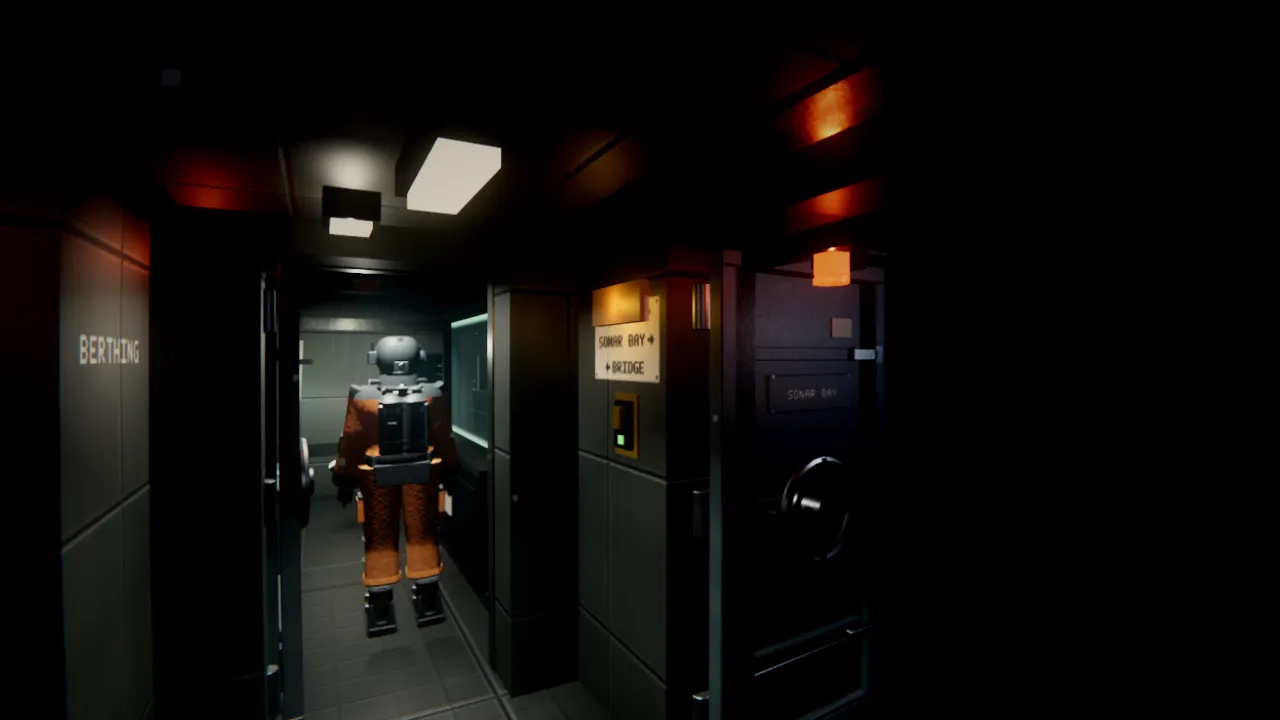
The corridor, from the current build.
The idea
Most co-operative games give every player the same information and ask them to divide up the work. We wanted to divide up the information instead.
So there is no HUD. No objective marker, no health bar, no interaction prompt floating in the middle of the screen. Everything the crew know about the ocean outside arrives through an instrument, each instrument lives at one station, and no station can see the whole picture.
Sonar hears a contact and knows its bearing and its range. It does not know what the contact is, and it cannot see where the boat is pointed. The helm knows the course and the ordered speed, and cannot hear the contact. Engineering knows the plant is running hot and that something is drawing power it should not be, and is two compartments away from anyone who needs to hear that.
The picture only exists if somebody says it out loud. That is the game.
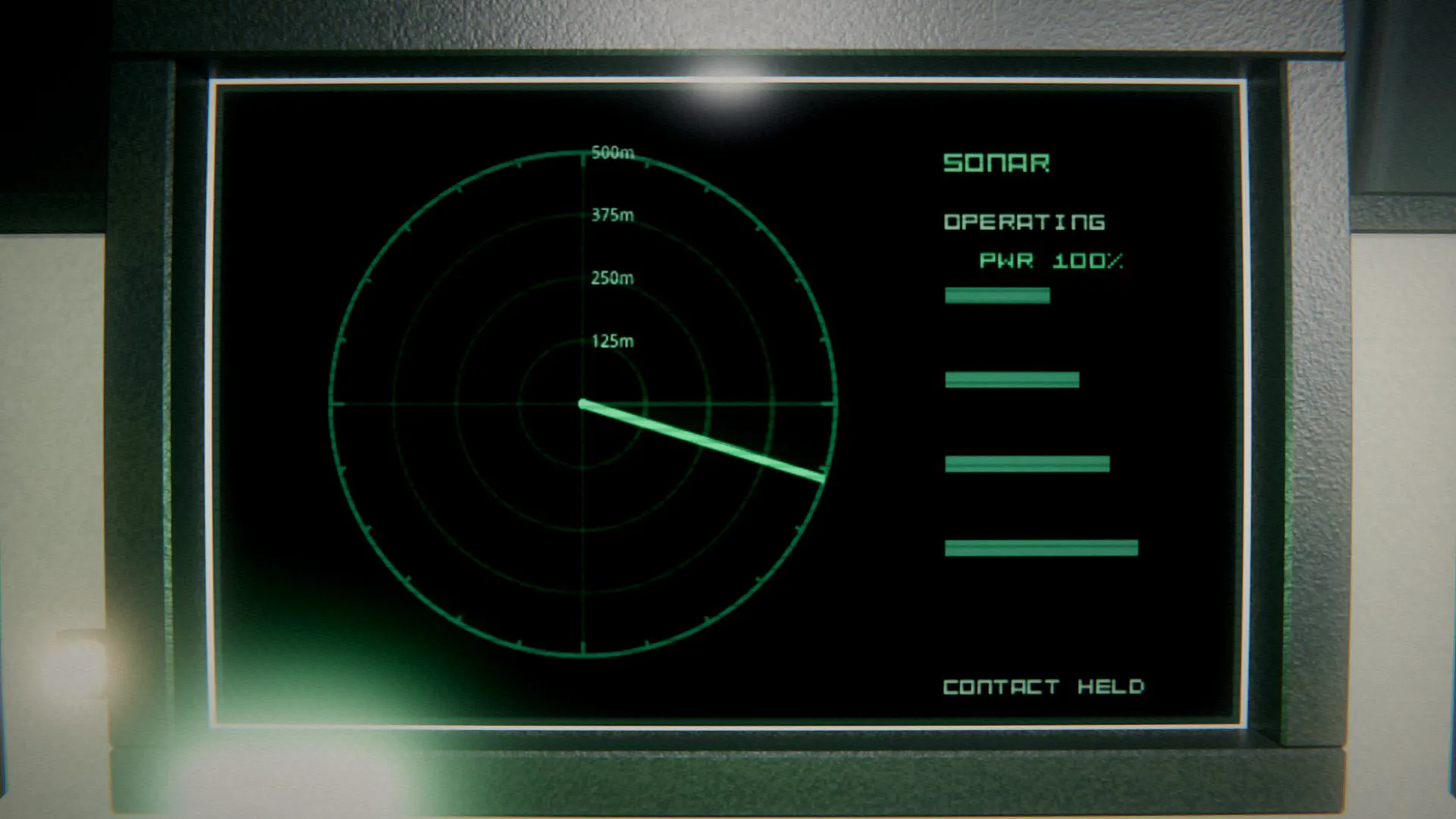
Sonar holds a contact. Bearing and range, and nothing about what it is.
Professional work, until it isn’t
Expeditions start as credible assignments. Map a trench. Recover a lost instrument. Survey a migration. The crew are specialists doing a job they trained for, in a vessel they are learning to trust — and learning to trust a vessel means learning what it sounds like when it is fine.
Then the rules start to fail. Sonar detects a contact inside the submarine. A probe returns footage from a place it has not reached. A corridor measures longer than the boat.
The horror we are chasing is not that something is hunting you. It is that the instruments you have relied on all dive are still working perfectly, and are telling you something that cannot be true.
Where it actually is
Being straight about this matters more to us than a good screenshot, so:
A vertical slice is playable today. It runs in Godot 4. It has six compartments and five watertight doors, five crew stations, one authored expedition, a power-and-heat plant that can trip, a survey chart the crew build together from what they each heard, localised damage with repairs somebody has to physically walk to, and four-player networking with proximity voice and text.
It is not finished, and it does not look finished. Every screenshot on this page and on the game page is a real capture from that build, and that build is greybox with dressing on top. The systems are real. The art is not done. We would rather show you the honest version now than a polished version of something that does not exist.
Some of the design is ahead of the build. Probes and drones are designed and not built. There is one authored expedition, not a campaign. We will keep saying which is which.
Four players is a complete crew, and the boat has five stations. That is not an oversight and it is not a build limitation — somebody doubles up, and deciding who is the first real decision a crew makes. Below four, stations combine and limited automation covers the gap: it will hold a heading and flag the obvious, and it will not classify a difficult contact or decide whether a lead is worth following.
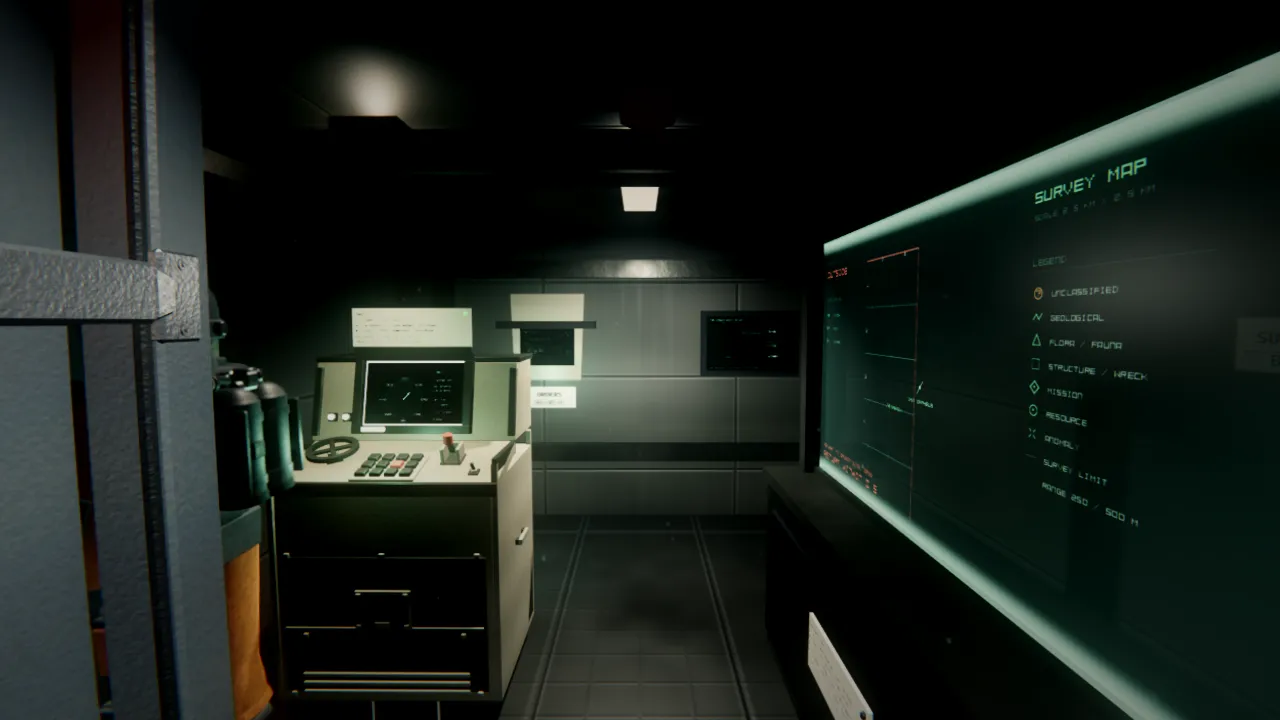
The bridge. The survey chart on the right is the crew’s shared picture of where they have been.
We need playtesters
This is a game about four people talking to each other under pressure. It cannot be tested alone, and it cannot be usefully tested by the people who built it — we already know where everything is, which is exactly the knowledge a real crew does not have.
So we will be running closed playtests as the slice firms up. If you want in, email us and tell us which platform you are on, and whether you can bring three other people or would rather be placed with a crew.
We are not fixing a date. We do not have one worth promising, and we would rather say that than invent a month. We will write to you before the first session.
And PULSE//ZERO
PULSE//ZERO is not going anywhere. The public beta is still on itch.io, still pay-what-you-want, and still getting patches.
Northforge self-publishes, which means nobody outside the studio sets our schedule. It also means we only get to work on two games at once by being honest about what state each of them is in. That is what this post is.
If you want the technical version, the first devlog is up alongside this post: what a game with no HUD actually costs — including the light switch that only announced itself in rooms you could already see.
- no-return-depth
- announcement
- playtest